No images? Click here


The Rise of TSR Multipliers in LTI Design
During this AGM season to date, a material number of those companies seeking approval for revised directors’ remuneration policies are proposing increases to incentive quantum; so far 65% of FTSE 100 companies seeking to renew their policy in 2026 are increasing variable pay levels to some extent.
The most common approach is to simply increase the headline LTIP award levels (possibly while reducing the percentage of the award which vests at threshold so there is some level of additional out-performance built in as a quid pro-quo for the increase).
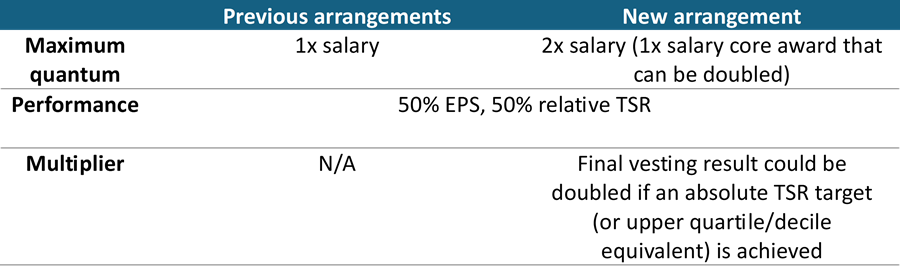
However, one relatively new trend is interesting. A number of companies have kept the headline LTIP award level unchanged and, instead, incorporated a Total Shareholder Return (TSR) multiplier. We have seen a handful of FTSE 350 companies incorporating such multipliers into their LTIPs in 2025 and 2026, with almost all of these linked to TSR. Increasing overall quantum in this way seeks to reinforce performance alignment whilst providing a clear link to shareholder value creation.
A simple example of how this could operate is illustrated below:
Pros & Cons of TSR Multipliers

While these structures are attracting interest, it would be overstating the position so far to describe them as widespread. Multipliers remain minority practice, and importantly, those companies that have introduced them have faced significant shareholder and proxy scrutiny (albeit they have typically been accompanied by other unusual features as well and it would be too simplistic to attribute any negative reaction wholly to this feature):
- Some proposals incorporating multiplier features have received only moderate support levels from shareholders
- In at least one case, a company withdrew its remuneration policy resolution following investor feedback
Proxy advisors have also highlighted concerns in specific situations, particularly where multipliers:
- Add additional layers of complexity (e.g. pre-grant and pre-vesting conditions combined)
- Contribute to a significant increase in maximum quantum
- Sit alongside other governance concerns (e.g. plans with limited holding periods)
Investor sentiment on this issue therefore appears relatively cautious, though multipliers may be supported where rationale is strong and clearly justified.
Accounting Implications (IFRS 2)
The introduction of a TSR multiplier overlay has important accounting consequences.
Where the multiplier applies to the entire award, the award is now considered to include a market condition across its full scope. This will likely mean a company will need to run a more sophisticated model (i.e. a Monte-Carlo simulation) to determine the fair value of this award.
The complexity of valuation potentially increases, particularly where multiple performance conditions interact.
In principle, introducing additional performance conditions or “hurdles” tends to reduce the fair value on a per-share basis, as it makes the award harder to achieve. However, where a multiplier increases the number of shares that can vest (for example, by scaling up awards for strong performance), this can offset the lower per-share value. As a result, the total accounting charge may in some cases increase, depending on the specific design and application of the multiplier.
How FIT Can Help
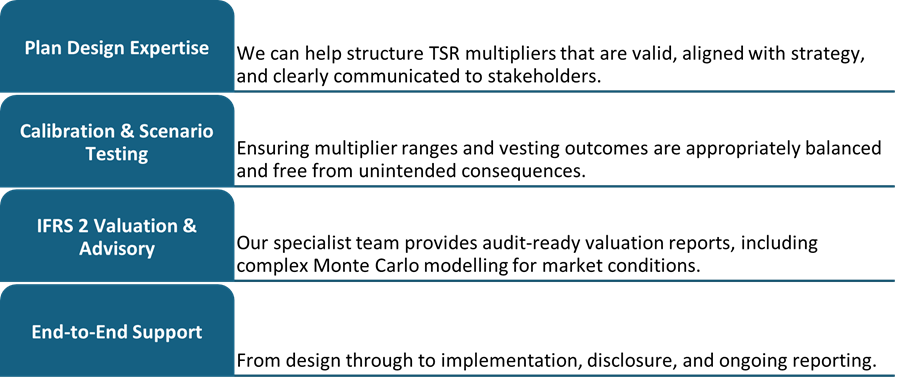
In addition to our core remuneration committee advisory work, our analytics team is well-positioned to support companies navigating this evolving landscape:
Conclusion
While still minority practice, TSR multipliers are becoming a more common feature of LTI design, offering a mechanism to balance higher reward opportunity with enhanced performance expectations. However, they introduce additional complexity—both in design and accounting—which requires careful consideration. With the right expertise, companies can harness these structures effectively while maintaining strong governance and transparency.
It should be noted that multipliers are far from the norm and companies should consider LTIP design in the round noting that a couple of other trends are also emerging:
- The overriding need to ensure quantum remains competitive
- There is greater focus from investors on the appropriateness of comparator groups (if adopting relative TSR), particularly where US peers are used to justify higher pay levels
- An increasing number of companies adopting hybrid plans (a combination of performance shares and restricted shares, now operated by 10% of FTSE 100 companies): while the latest IA guidelines suggest these may only be appropriate in US-centric businesses, our experience is that a number of institutional investors are supportive even in more domestic businesses and, certainly, some favour this to pure restricted share plans which have previously been seen as the only alternative to pure performance shares
While we have not seen a move away from the use of ESG-based measures in long-term incentives (unlike, say, in the US), there are examples emerging of companies reducing ESG weightings, particularly where shareholder returns have been disappointing and Boards wish to demonstrate more of a focus on such returns over ESG-based metrics.
We are actively working with numerous clients on these issues and would be pleased to discuss them further.
Legality of buy-out awards in the US
For readers with significant operations in the US, it is worth noting that new laws came into force on 1 January in California (but with potentially wider application) which restrict the recoupment of awards made on joining linked to continued employment. So previously acceptable buy-out awards made on joining with provision for repayment on cessation of employment may no longer be enforceable. A more (UK) standard provision where the payment is only made later at the end of any vesting period is more likely to be enforceable. There are detailed exemptions, but full compliance is required so particular care is needed.
If you wish to discuss anything arising from this briefing, please ask your usual contact at FIT or email us using the button below.
Partners
Rory Cray
rory.cray@fit-rem.com
020 7034 1116
Darrell Hare
darrell.hare@fit-rem.com
020 7034 1113
Matt Higgins
matt.higgins@fit-rem.com
020 7034 1117
Alison Kidd
alison.kidd@fit-rem.com
020 7034 1773
John Lee
john.lee@fit-rem.com
020 7034 1110
Sahul Patel
sahul.patel@fit-rem.com
020 7034 1778
Iain Scott
iain.scott@fit-rem.com
020 7034 1114
Matthew Ward
matthew.ward@fit-rem.com
020 7034 1777
Martin MacLeod
martin.macleod@fit-rem.com
020 7034 1111