No images? Click here


Remuneration-related considerations in advance of an IPO
The start of 2026 has seen a growing sense of optimism that the UK IPO market could be finally returning after a prolonged dry spell. High profile IPOs in the second half of 2025, which included the likes of Shawbrook, Princes and The Beauty Tech Group, demonstrated that there is investor appetite for well-prepared issuers with a compelling equity story and that the IPO route is a viable option. When combined with an improving market outlook and stabilising inflation, there appear to be the green shoots required to revive the UK IPO activity over the months ahead.
Moving from private ownership to the public markets is a truly transformative step for a company —one that reshapes everything from strategy to culture. How leaders and employees are rewarded is one important consideration, particularly when taking into account that remuneration structures often look markedly different pre and post IPO.
Whether listing on the Main Market or AIM, there are several important considerations to work through well ahead of listing day. This briefing highlights the key issues that should be front of mind for any company planning to go public within the next 12–18 months.
1. Resolving existing remuneration arrangements
Typical practice:
Pre-IPO incentive plans, particularly for those with private-equity backing, are typically exit-based and pay out on an IPO or trade sale. The outcomes of pre-IPO equity arrangements are typically formulaic in nature, with very little room for the application of judgment.
On IPO, shares in the private company are converted into shares in the listed entity, with Executive Directors often able to sell a portion of these shares and hold the balance.
Key considerations:
Although “lock-up” sales restrictions will typically apply for a period post IPO, the flotation can be the first opportunity for Executives to realise significant value. How much can be sold is often determined through a discussion with the existing shareholders and IPO sponsor with the avoidance of creating any negative perceptions of future growth potential a key factor. Typically, we see at least a 12-month lock-up window.
Generally, companies try to crystalise any non-standard arrangements shortly prior to an IPO to minimise potential complications during the listing process. While this is not always feasible, framing such arrangements as legacy items – and clearly indicating that they will not be repeated in the listed environment – can help present a clean and transparent position to prospective investors.
Potential issues we often assist with:
Crystallising an existing scheme as part of the IPO can generate significant, sometimes life-changing, amounts for individuals, which, may itself create a potential retention issue. It can also act as a natural break point for executives who may be less excited by the generally lower risk/reward profile of UK listed company pay arrangements. The solution is often addressed through a combination of points 2 and 3 below.
Are there any senior executives who have joined later and therefore “missed out” on the value created? We have helped a number of companies with top-up awards or a reallocation of existing awards which are intended to rebalance the value earned on an IPO and to better recognise the contribution of executives rather than just their longevity in role.
2. Transitional / one-off arrangements
Typical practice:
In order to address any concerns with retention and/or where late joiners are not adequately rewarded, a number of companies will use one-off awards at or just before IPO.
The motivation behind such awards can vary; some companies make awards to address differentials between team members, others to recognise contributions to the IPO process and others to fill a potential “vesting gap” between the realisation of value at IPO and the first releases under any post-IPO long-term incentive – which will normally be at least three years away.
Some companies have granted larger one-off awards to supercharge performance in the crucial post-IPO period to align with a growth story.
Key considerations:
It is very difficult to make one-off awards after a company has listed due to corporate governance constraints, so it is important to consider whether any “bridge” awards are appropriate before/at IPO.
By their very nature, these types of awards are specific to the circumstances of each company (and the individuals) and so are the issues they are seeking to address. Some companies will grant a form of restricted shares to focus on retention, whereas others will grant performance awards which incentivise and reward for growth in the crucial one- to three-year period post-IPO.
In some cases, something beyond “normal” is seen as needed to make the overall package exciting enough to those who may be inclined to use the IPO as a natural break or as the opportunity to join another build project.
Potential issues we often assist with:
Is there a genuine need to grant any special awards at or before IPO? Understanding the key driver for awards (is it retention, is it performance, or is it a bit of both?) can help determine whether this is best managed through one-off transitional awards or through modifications to the ongoing remuneration arrangements.
If one-off bridge awards are required, we often help companies with identifying who should participate and how awards should be allocated. Establishing what the performance criteria should be (if any) will be a key consideration.
Some companies also wish to mark an IPO as a special achievement and grant share and/or cash awards to all employees. Implementing this in a cost and tax-efficient manner can make the awards more valuable and meaningful.
These arrangements can be material and effectively replace the regular LTI awards for the first three or so years post-IPO.
3. Ongoing remuneration arrangements
Typical practice:
Remuneration structures and levels from IPO are likely to need to reflect a version of "market normal" in order to receive the backing of new investors.
As any increase in pay at a listed company will be heavily scrutinised, it is vital to get pay "right" at IPO. Whilst a generalisation, private company base salaries (and packages) are in many cases below PLC listed company levels and so companies tend to re-benchmark senior executive pay packages prior to IPO and will generally either move to around the market expected levels of base salaries, or set out a plan to transition to the desired rate over a period of time.
There are a number of "shareholder-friendly" pay design elements in the PLC package which may seem unattractive to Executive Directors coming from the private sphere (e.g. annual bonus deferral, post-vesting holding periods and shareholding guidelines) but which are generally accepted as the "cost" of being an Executive Director of a listed company.
Key considerations:
The parameters for what constitutes “market practice” for UK listed companies is relatively narrow. Whilst this means it is arguably easier to establish a robust benchmark, it also means there is limited choice for those companies wishing to present themselves as market conforming.
We have seen some lobbying recently for making the governance of remuneration in the UK less onerous (as part of an overarching aim to make UK listed pay more competitive) – with some evidence that investors are willing to tolerate some relaxation in some aspects of pay design in response (e.g. more use of international pay benchmarking and less onerous bonus deferral mechanisms). However, there remain some red lines for UK investors and proxy agencies when designing post-IPO pay arrangements:
- Base salaries – still difficult to make material adjustments for Executive Directors in a listed environment, with the default expectation that any increase will be in line with the wider workforce
- Pension – to be aligned to that offered to the wider workforce (as a % of salary)
- Annual Bonus – a capped annual bonus based on the achievement of performance criteria which will be disclosed (targets and actual results disclosed retrospectively, but measures and weightings to be disclosed prospectively) with part of any bonus deferred into shares (noting that some companies have recently reduced or removed deferral once the shareholding guideline has been met)
- Long-term incentives – more variation in vehicles in recent years, but the sole use of a performance share plan remains the most common approach (the use of restricted shares or hybrid plans – i.e. a combination of performance and restricted shares – remains minority practice). Expected that LTIs have a minimum three-year vesting period, with a further two- year post-vesting holding period for Executive Directors
- Shareholding guidelines – requirement to build a holding of at least 200% of salary (expectation this will be higher in larger companies) through retention of vested awards and a further overlay that these should be retained for two years post cessation.
Tax efficient all-employee plans, such as HMRC-approved Sharesave and Share Incentive Plans, become more viable once there is a ready market for shares and many companies include provision for such arrangements at IPO even if they do not immediately implement them.
Potential issues we often assist with:
What is the most appropriate peer group and pay positioning? The most common approach is to use a pan-sector group determined by reference to market cap supported by robust sector comparisons (to the extent they exist) and move pay levels to (or above) the median of the peer group at IPO. As there tends to be less scrutiny of pay levels at IPO, a minority of companies will consciously set salary levels and variable pay multiples (as a percentage of base salary) at a premium to median levels to provide future headroom.
To what extent should other executive salaries be increased and when should changes take place? There is not normally such a differential between private and listed Executive Committee salaries and there is a danger that senior executive increases lead to pressure to increase salaries at lower levels.
Changes to base salary need to be considered alongside any incentive changes being contemplated (i.e. annual bonus and LTIP quantum which are usually driven off salary). A higher variable pay potential may offset lower salaries.
In our experience, the impact on the Income Statement (noting that other elements tend to be driven off the base salary) is an important consideration for the selling shareholders as it may influence the value of the business at IPO. Phased increases, or stripping out certain elements as “adjusted items” may be required to manage the overall costs. Indeed, on occasion, we have seen companies disclosing a reference salary for a founder CEO to indicate what the market level for any future successor will be while retaining his or her actual salary at a lower level.
Over the last year or two, we have seen increased focus amongst the most global companies in using a broader peer group to include more international companies than has been the historic norm. If this (or other bases for operating a more bespoke pay model) could be relevant, it should be considered as part of the preparation for IPO rather than surprising investors with a request following listing.
4. Reporting and compliance requirements
Typical practice:
The IPO prospectus will typically set out the following for the Executive Directors:
- Base salaries post IPO (few explicitly disclose the pre-IPO salary but it can often be recalculated from other disclosures)
- Benefits and pension provision
- Annual bonus maximum (and potentially the performance measures to be used post IPO if already agreed)
- Long-term incentive awards to be granted post IPO, including award levels, performance measures and performance targets (if already agreed)
- Details of any legacy arrangements which roll forward into the PLC environment – could refuse to disclose targets on the basis of commercial sensitivity (but would potentially be difficult to argue)
Some companies will also provide an outline of the wider remuneration policy terms which will be required to be put to shareholder approval at the first AGM.
In relation to remuneration, the prospectus will also set out:
- The main terms of the deferred bonus and LTIP rules
- The main terms of any all-employee share plans
- Expected shareholdings for the Executive Directors
The respective reporting rules once listed differ between Main Market and AIM, but both involve a substantial increase in the remuneration disclosure. Recent changes to the QCA Code have arguably closed the gap between the two, with an expectation now that for AIM companies there is an annual advisory vote on the remuneration report and a periodic vote on the policy report (which is binding for Main Market companies but can be advisory for AIM companies).
Key considerations:
The greater level of disclosure often influences the design and implementation of pay. Annual bonus and LTIP awards are granted in the knowledge that the performance measures and targets which are set will eventually need to be disclosed and therefore subject to public scrutiny.
The proxy agencies also analyse and assess public disclosures and provide voting recommendations to their members. The main UK proxy agencies tend to have a lower level of coverage for AIM companies, but produce comprehensive reports on the pay arrangements at Main Market companies. ISS, in particular, can be influential in affecting overall voting outcomes.
Potential issues we often assist with:
In our recent experience, different auditors (even within the same firm) have inconsistent views on whether a company needs to report pre-IPO pay in the first remuneration report (sometimes depending on whether a new holding company is inserted at IPO), so it can be helpful to get early confirmation from them in order to help shape the reporting approach.
Explaining pre-IPO pay and making clear it is part of legacy arrangements can be key to avoid tainting the forward-looking policy.
Ensuring compliance with regulatory requirements (which have changed multiple times in recent years) as well as addressing the hot topics for investors and proxy agencies can be difficult if the Reward and/or Finance team have limited listed company experience. There is often a steep learning curve in the first year of reporting as required disclosures such as CEO pay ratios and the like have a number of complexities and potentially require more time commitment than is perhaps initially appreciated. Thought also needs to be given as to when Non-Executive Directors will be appointed as this will shape how involved they can be in the design of the remuneration arrangements.
Additional useful information available
The limited number of UK IPOs over the last three years or so means there is little recent data to study but we note some of the key highlights below from the three most recent Main Market IPOs:
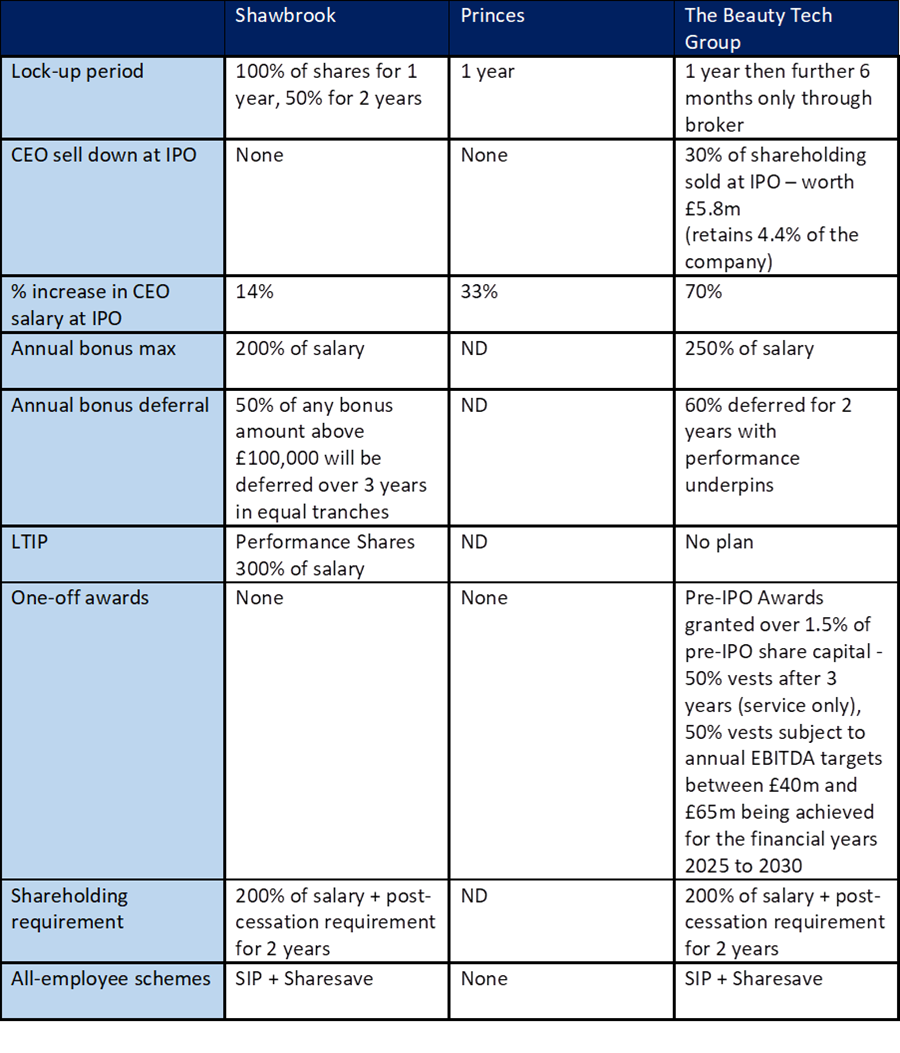
Our comprehensive IPO Review Survey can be requested here and provides detailed analysis of the large number of IPOs in the build up to and including 2021. Some key findings in the report which are highlighted again here are:
- The median CEO salary increase on IPO was 18%
- The median CEO post-IPO max bonus differential compared with its market benchmark was 0% - i.e. the bonus opportunity was set the same as other listed companies of a similar size
- The median CEO post-IPO LTIP face value differential compared with its market benchmark was +23% - i.e. the LTIP award was almost a quarter higher than other listed companies of a similar size. This may reflect that many newly-listed companies project a future “growth story”, and so having more significant long-term incentives is consistent with this outlook
- Half of companies set CEO total target remuneration within a range of +/- 20% of the median benchmark. This indicates that companies are setting CEO pay which is broadly competitive with the “market level” for companies of a similar market capitalisation at the time of IPO
- Around 25% of Main Market listings had some element of one-off award at IPO, whereas only 10% of AIM listings had something similar
- Around 60% of companies introduced a Sharesave and/or SIP at IPO but many did not implement it immediately
For more recent information on current pay levels and key trends, please see our FTSE 100, FTSE 250, FTSE Small Cap and FTSE AIM surveys (copies of which can be requested here).
Conclusion
As can be seen, there is much to be discussed and agreed in relation to remuneration in the build-up to an IPO. It is for this reason that sufficient space should be allocated in the IPO timetable to allow for full and careful consideration of the issues. The timeline for a listing can often be expedited depending on market conditions and therefore any remuneration review will need to be flexible, but it can be helpful to plan this out in advance even when an IPO is not immediately on the horizon.
Supporting the needs of the business in terms of recruitment, retention and motivation remains the key to a successful remuneration policy but this has to adhere to stricter governance and disclosure requirements in the public markets. Prior knowledge and experience of the listed company environment can significantly help with navigating these challenges. The early appointment of Non-Executive Directors and, in particular, a Remuneration Committee Chair, will provide for more joined up thinking and buy-in from the relevant parties.
A MESSAGE FROM OUR MANAGING PARTNER
FIT is pleased to welcome, this week, Martin MacLeod as a new partner. Martin has joined our implementation team from a major law firm and is extending our support to clients with share plan and related implementation work. We are pleased to have him on board and look forward to our clients getting to know him over the coming months.
If you wish to discuss anything arising from this briefing, please ask your usual contact at FIT or email us using the button below.
Partners
Rory Cray
rory.cray@fit-rem.com
020 7034 1116
Darrell Hare
darrell.hare@fit-rem.com
020 7034 1113
Matt Higgins
matt.higgins@fit-rem.com
020 7034 1117
Alison Kidd
alison.kidd@fit-rem.com
020 7034 1773
John Lee
john.lee@fit-rem.com
020 7034 1110
Sahul Patel
sahul.patel@fit-rem.com
020 7034 1778
Iain Scott
iain.scott@fit-rem.com
020 7034 1114
Matthew Ward
matthew.ward@fit-rem.com
020 7034 1777
Martin MacLeod
martin.macleod@fit-rem.com
020 7034 1111