No images? Click here


EXECUTIVE PAY – DOES BEING PRIVATE BEAT BEING PUBLICLY QUOTED?
Too much of a good thing?
The regulation and disclosure regime relating to the pay of directors of London-listed companies has burgeoned over the last thirty years. The nature of engagement with investors and the corresponding expansion of shareholders’ rights has also changed. This, the globalisation of the investment management industry and the consequential rise of proxy advisors have made the engagement process impersonal, semi-algorithmic and often a frustrating process for all concerned. Pay at all levels is a sensitive subject. Getting pay right matters, but opinions differ widely among investors and executives themselves on the right answer – not only design and structure but also how much is enough.
The UK remains the only country in the world with anything comparable to The Investment Association’s Public Register. The Register has, since 2017, maintained a list of the companies in the UK FTSE All Share which have polled 20% or more votes against any resolution put to shareholders or where a resolution has been withdrawn before shareholders have voted on it. The IA (backed up by the UK Corporate Governance Code) applies a high standard to the definition of ‘significant dissent’. After all, 50% + 1 vote is enough for an ordinary resolution to be approved. The IA’s purpose in suggesting the idea in the first place was to create a mechanism “to identify which companies are acknowledging shareholder dissent and how they are addressing their shareholders’ concerns.” In truth, the consequence is that many remuneration committees and their chairs feel that, despite a well-intentioned investor consultation process, they cannot win on the pay and governance front especially if they want to do something original and not what the proxies might call ‘best market practice’. Remuneration committee chairs may not be tempted to be less bold and creative on pay as a consequence but they know it will add to their time commitment and workload if the vote on remuneration is 20% or more.
Last Autumn, the Capital Markets Industry Taskforce (CMIT) said: “We feel that too often the current regime, particularly in the stewardship space, is set up by default to be antagonistic to demonstrate challenge and such a regime cultivates mistrust…. Engagement with shareholders has to include a balanced and constructive dialogue in relation to remuneration policy.” Among other things, CMIT called for the abolition of the Public Register.
Recent remuneration changes enforced by the UK Corporate Governance Code have been bad news for UK listed company executive directors: reductions to contractual pension allowances; post-vesting holding periods; post-employment share ownership policies; and extensive clawback and malus provisions. UK plc incentive plans also tend to have higher thresholds for initial payments than is the case in the US as well as the overall quantum available in the UK being lower. For example, the governance tenet upheld in Europe that no remuneration linked to relative Total Shareholder Return (TSR) performance should vest for below median performance does not apply in the US where vesting often starts at the 25th percentile. Also, and the British propensity for deferring bonuses although it has become much more common in Europe, is not a feature of US design, at least outside the financial services sector.
Executive directors have left the listed company world feeling cheated by the enforced reduction of contractual pension allowances to align with those for all employees only for their new PE-backed employer to restore the original allowance and deliver the annual bonus wholly in cash.
This may be part of the reason that the number of listed companies has fallen over the last twenty years, by 30% or more. The question we want to pose is this: is it easier for privately-owned companies - where the ‘principals’ are much closer to the business and to the ‘agents’ - to strike the balance on pay that many listed companies feel eludes them?
Private companies are a broad church …
The Wates Code which imposes reporting requirements on larger private companies was published in 2018 in the wake of the BHS pension scandal. The Code applies to privately-owned companies that satisfy either or both of the following conditions: more than 2,000 employees or a turnover of more than £200 million, and a balance sheet of more than £2 billion. There are about 1,800 private companies in the scope of the requirements. The Code points out that private companies “are not a homogenous group and are established under a variety of differing ownership and legal structures, including family businesses, private equity-owned businesses, sole owners and subsidiaries.” For this reason, perhaps, the Wates Code devotes scarcely a page to what is required in respect of remuneration in contrast to the two and a half pages in the (new) UK Corporate Governance Code which are, of course, supplemented by various institutional shareholder guidelines and other recommendations.
The range of industries covered by private companies is wide and the types of owners range from:
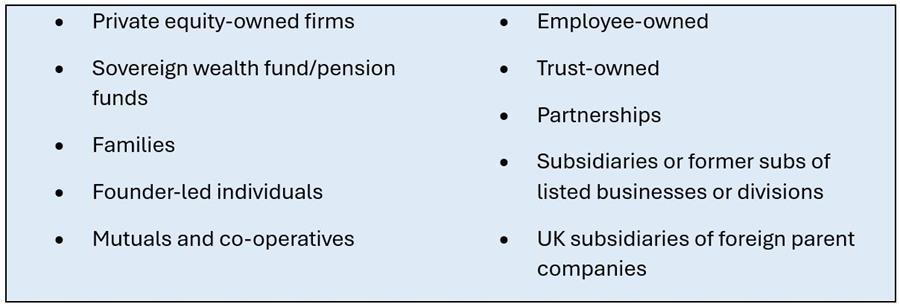
...but have points in common with listed employers as well as differences
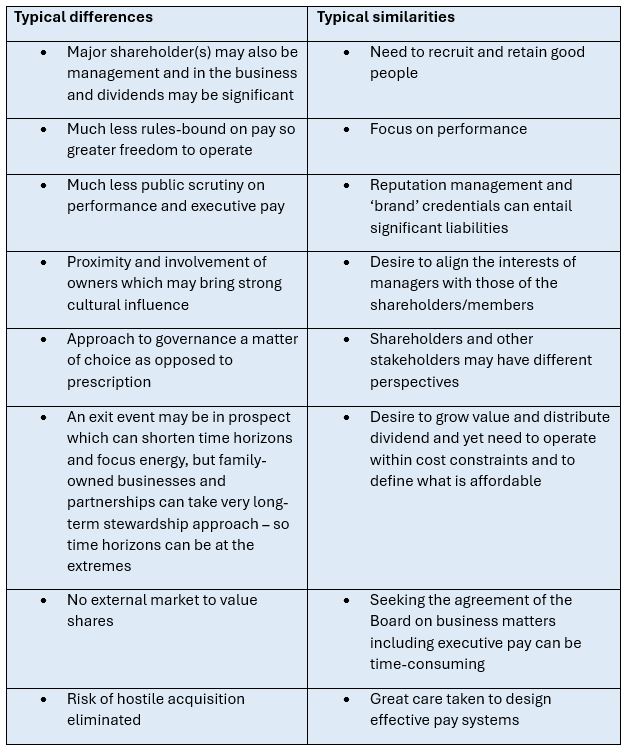
The overall approach to remuneration in private companies
History, philosophy and sociological beliefs and events all shape policy and practice. The key questions are :
- Why does the company exist?
- What is its purpose?
- What are the shareholders investing for?
- A ‘one-off’ LTI award is a logical and important reward component where the shareholder seeks an exit. Where the goal is long-term “stewardship” and to pass a thriving company to the next generation of the family, there may be no long-term element of pay at all.
The factors which shape pay in private companies also include:
- The views of the founder and/or owners and the governing documents of the company.
- The need to retain control of voting rights.
- The desire or otherwise for tax-effective design.
- Likelihood of an ‘exit’ event.
- The nature of exposure to skills pressures and talent markets – international or otherwise?
- Appeal, profitability and business cycles of the sector.
- Scale and sector: retailers tend to have a different approach from professional services organisations.
Private equity-owned companies are generally perceived to be the major threat to listed companies when it comes to the effectiveness (and lure) of their approach to remuneration for the leadership team. The added attraction to executive teams, as well as the potential value to be accessed, may be the thrill of an ‘exit’ event and, provided the business is successful, a significant pay out could be delivered in, say, five years.
The approach taken in private-equity companies is usually highly pragmatic as well as tax-effective. With caveats to our readers against over-reliance on generalisations, we offer the following ‘thumb-nail’ sketch of the approach to pay design in a private equity-owned trading company:
- Base salary and annual bonus broadly in line or above levels in listed equivalents although PE-owned companies may place less of a premium on ‘back office’ roles.
- Benefits in PE-backed companies are often minimal. We see a varied approach to benefits in private companies generally.
- Bonus participation may be limited to a senior few and payouts triggered only when the (tough) EBITDA budget has been reached. Bonus metrics often focus on EBITDA but we see a greater willingness to use more bespoke measures and to experiment and adapt. By contrast, introducing measures on an experimental basis and then withdrawing them can be embarrassing in a listed company.
- A Management Incentive Plan (MIP) or value creation plan which:
o might provide for a share of the ‘increase in value’ from 2% to 20%+, often subject to a hurdle.
o Participants may be obliged to ‘pay to play’ and may borrow some or all of their investment on commercial terms.
o Many plans have a ratchet which increases the pool to be shared as the level of performance above the hurdle increases.
o Eligibility for plans is often concentrated on the senior team (although professional services firms seem to us more likely to require wider participation and share something like 6% to 8% of the equity/value created) and may include the non-executive directors.
o The sharing rate also varies i.e. how much of the ‘pool’ should be allocated to the CEO, CFO, COO, other members of the team and more broadly. Where the CEO is a founder the sharing rate is likely to be higher e.g. 40% to 50% of the total. We often see the lion’s share go to the CEO and CFO (say half the pot with the preponderance to the CEO).
o MIPs are often designed to be tax-effective with any payouts realised on exit subject to capital gains tax at, currently 20%, as opposed to the rate of tax currently payable on vested shares or cash payouts of effectively 47% (45% being the top rate of income tax and 2% NIC).
o Leaver provisions are often more restrictive than is the case in listed companies. The PE house may seek to buy-out even good leavers on cessation and hence there is no future upside after cessation of employment as there would usually be for good leavers in a listed company.
It remains to be seen what tack the new Government takes on any tax-effective share-based arrangements in private companies given the need to balance a business-friendly approach with the cost demand on public services. (The Labour Party’s manifesto commits to the closing of the capital gains tax ‘loophole’ which benefits carried interest arrangements (widely used by the private equity houses)).The current beneficial arbitrage to income tax treatment may be reduced or removed entirely. At this point we think many companies will reconsider the undoubted complexity of these plans and consider whether, as many private companies already do, that cash-based arrangements are simpler, more flexible and more likely to support the business.
We are often asked about tax efficiency for share-based long-term incentives in private businesses where there is no clear exit plan. These can work well but the question is: who pays? On an exit, it is the buyer. In a long-term hold business such as a family-owned company, or a mutual or pension-fund owned business, Boards must decide if accruals to fund non-exit-related long-term incentive pay-outs calculated by equity value growth are affordable or appropriate. Sometimes management teams prefer an enhanced cash bonus perhaps with some deferral for retention over share-based long-term incentives because of the greater transparency and simplicity and because of the costs savings. The set up and on-going implementation of long-term incentive plans can be high.
Conclusion
Our observation is that, even though privately-owned companies have much greater scope to be original in their approach to design, many are influenced by listed company practice in terms of the main elements of pay – fixed pay; annual bonus and long-term pay. This is also generally the case in founder-led and family-owned firms even where dividends are significant. Private companies are however, able to offer the certainty of cash-based pay unfettered by PLC shareholder ‘protections’. The choices may be symptomatic of the market at work. Where the talent pool comprises listed companies (or the subsidiaries of listed companies in the UK) where executives are used to annual and three-year LTI awards vesting, many private companies follow suit.
There are important exceptions to this. Professional services firms typically avoid the need to value their firms or to set long-term targets by relying on annual variable pay. Others pay higher fixed pay to balance the absence of a long-term plan. John Lewis is a good example of a retailer which competes with many listed (and private) retailers which deploy annual and long-term incentive plans when John Lewis itself offers only fixed pay and profit sharing (which delivers the same percentage of salary to all). Even in very good years, the profit sharing has generally not exceeded 20% of salary. This demonstrates the importance of corporate ethos and non-monetary reward.
The main area for design innovation for private companies as against plcs perhaps lies in the long-term element of pay. Private companies, if they decide to have a long-term plan in the first place, can be bold here. Imagine for example a long-term incentive plan which allows for phased payouts from the date of the award and where the Remuneration Committee can vary the pay outcome in management’s favour if they think it is merited and without external hue and cry.
PE-backed companies do, though, tend to have a greater distinction between the ‘haves’ and ‘have nots’ with equity participation focused in fewer hands.
The Boards of listed companies may feel constrained on executive pay determination and outdone by private companies and out-gunned by PE-owned companies in particular. There are, however, advantages for both participants and shareholders in a remuneration cycles that are set annually and can be adjusted to reflect both company specific and macro performance factors and in which those who know the business best (the Board) have material input on target-setting and pay structures.
The perceptions of pay in private companies are skewed by the successes but a potentially lucrative one-off Management Incentive Plan has no value where there is no flexibility to change the five-year or more targets or where the exit event is uncertain or much delayed.
Successful management teams can earn considerably more than at equivalent listed companies but this comes with a greater risk of also earning considerably less.
September 2024
Partners
Rory Cray
rory.cray@fit-rem.com
020 7034 1116
Darrell Hare
darrell.hare@fit-rem.com
020 7034 1113
Matt Higgins
matt.higgins@fit-rem.com
020 7034 1117
Alison Kidd
alison.kidd@fit-rem.com
020 7034 1773
John Lee
john.lee@fit-rem.com
020 7034 1110
Sahul Patel
sahul.patel@fit-rem.com
020 7034 1778
Iain Scott
iain.scott@fit-rem.com
020 7034 1114
Richard Sharman
richard.sharman@fit-rem.com
020 7034 1774
Katharine Turner
katharine.turner@fit-rem.com
020 7034 1115
Matthew Ward
matthew.ward@fit-rem.com
020 7034 1777