No images? Click here


Competing for the best talent
Introduction
As our first briefing of 2024, we have prepared something a little different. Over the last few months, there has been much discussion regarding whether the current state of executive compensation for UK listed companies needs a fundamental reset. This includes various suggestions from the Capital Markets Industry Taskforce (CMIT) and others. At the time of writing, the Investment Association has delayed publishing its annual update to its guidelines as it considers these issues.
Clearly, readers will have differing views from those seeking to more closely align pay with US (and UK PE-backed) norms to those who feel that the status quo is acceptable (or even leads to overpayment).
In this fraught situation, our aim is to provide some fact-based analysis to the current challenges regarding executive pay in UK listed companies including offering an alternative model for FTSE100 pay norms which reset the UK against global norms. This includes elements which are contentious and, for example, the author does not favour increasing notice periods, but the purpose is to highlight how far adrift of global norms we have actually become. We would also encourage such discussion to fit in a broader discussion of pay across the entire organisation. We hope it will prompt further discussion.
Commentary
Over the last few months, there has been much debate regarding reasons for the decline in the importance of London Stock Exchange over the last decade or so (with the number of constituents across the Official List and AIM reducing by 22% over the period January 2015 to May 2023).
Recently this has been exacerbated through a number of larger companies having either delisted or announced plans to do so (including CRH, Ferguson and TUI) while a number of IPOs which may have been expected to occur in London have done so elsewhere (notably ARM).
While it clearly overstates the position to lay the blame for this at the unwillingness of UK PLC as a whole to reward executives appropriately against global norms, it has been a major contributing factor over the last 15 or so years. While other political and macro-economic factors all contribute to this, our focus remains on executive pay.
Over this longer period, three separate thematics have arisen which have made UK listed companies a less attractive home for executives:
1. Institutional shareholder (and proxy agency) focus on avoiding overpayments has led to the development of a number of uniquely UK centric additions to UK executive remuneration design which, while well intentioned, have each made overall packages more complex and less attractive – these include:
- bonus deferral – outside the UK (ignoring FS) deferral of part of bonus into shares contingent on continued employment for 2 or 3 years is highly unusual whereas deferral of 33-50% of the headline bonus in this way is the norm for UK listed companies, even into the FTSE SmallCap although much less so on AIM
- post-cessation share ownership guidelines – in the UK, it is now expected that Executive Directors will retain a shareholding of at least 2-3x salary for at least 2 years after leaving office. We are not aware of an equivalent provision having been adopted in any other major economy. And we often find widespread frustration at Board level as to how this overlaps with LTIP two year post-vesting holding periods
- scale-back of LTI grant values where the share price has fallen materially (generally interpreted as 25-30%) – this is now expected in the UK whereas, again, this is not a global norm and, indeed, internationally the absence of such scale-back has generally been thought of offsetting lower levels of bonus or legacy LTIP vesting in such periods
- restricted stock – while the recent change in guidance from LGIM to permit the combined use of traditional LTIPs and restricted stock in certain circumstances is welcomed, most UK investors have opposed this approach. It should be noted though that, outside the UK, restricted stock refers to share awards which are only contingent on continued employment (no pre-vest performance conditions) whereas, in the UK, investors expect there still to be performance underpins (such as thresholds on financial, TSR or customer metrics) to prevent ‘payments for failure’ and so restricted stock awards are operated less favourably in the UK than elsewhere
- share plan dilution – whilst typically not an issue for the largest companies, the UK’s rigid adherence to “10% in 10 years” dilution limits and with an internal 5% limit for executive plans is a common problem for growing companies to navigate around, often making it difficult to offer meaningful share plan awards to wider groups of tech-led innovators within these companies.
2. Actual stock market performance has been lacklustre in the UK versus many global markets. While it is possible to debate cause and effect, the fact remains that successful executives in successful global companies have seen greater equity values than their counterparts in UK listed companies. An irony about this particular point is that the same institutional investors which have pushed for the current onerous regime outlined under point 1 above have, at the same time as introducing such measures here, moved the capital they manage to other markets which do not impose such requirements.
3. Quantum – in our experience, headline quantum has historically been less of a concern to many executives than the above points. However, UK pay levels are now falling so far below not only global norms but, often more pertinently, the levels of pay available in UK PE-backed companies as to make UK PLC roles so much less attractive than was historically the case. Whereas the latest LGIM guidelines and the CMIT (see our briefings at here and here) call for greater flexibility for companies with significant non-UK (particularly US) operations, the risk of poaching by entirely UK based PE-backed companies is far from limited to such internationally focused PLCs and the position is rather more widely felt.
While disclosures are less than perfect, our analysis of departing Executives Directors suggests that an increasing number of departing CEOs (potentially currently a majority) who are leaving for another full-time role will take such role outside the UK listed sector. This worrying trend needs to be recognised rather than ignored.
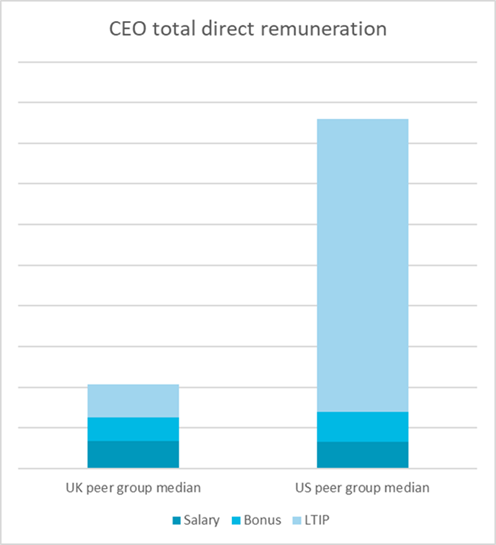
Our analysis of comparing on-target pay levels of equivalently sized UK v US listed companies shows a very material difference. While a simple pan-sector chart can be misleading as sector variances tend to be more significant in the US than the UK, some recent client analysis is felt to be indicative of a broader picture which showed comparable median salary and bonus data in both countries (although the whole of the US bonus amount would be payable in cash at the year-end) but significantly greater LTIP levels leading to:
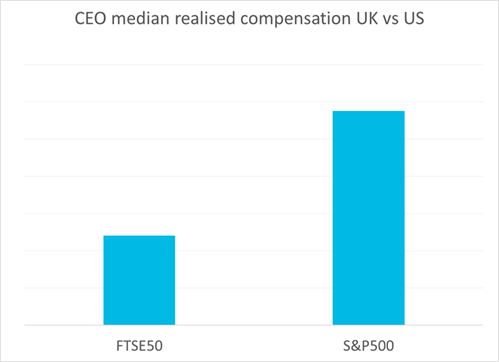
This can also be seen when comparing median realised pay levels at FTSE50 companies v S&P500 companies (groups with comparable market caps):
A way forward?
While recognising that the performance of UK-plc as a whole will be significantly impacted by macro-economic factors, it seems to us that, if companies are to hire and retain truly global calibre executives, there needs to be a much greater willingness both to roll back much of the “governance-led” complexity added in recent years and to ensure that packages are suitably competitive as to attract the right talent. In other words, underpaying high performing executives is a false economy if it leads to a talent drain to companies financed outside the London listed markets. In our view, improving points 1 and 3 above (complexity and quantum) should make a significant contribution to point 2 – better executives should lead to better corporate performance.
And to be clear, this is not to suggest higher levels of pay for all but rather greater differentiation in pay levels, i.e. the very best performing executives could earn significantly more than now but with lower levels (whether the current pay levels or even lower) for those performing less well and/or greater potential pay for those who compete for US talent.
Seeking to address institutional shareholders’ concerns with the current model together with addressing some of the concerns raised in this Briefing, and recognising that we are firmly opposed to any ‘one size, fits all’ approach, a straw-man for discussion which would align us more closely with global practice could potentially be as follows:
Potential straw-man for FTSE100 companies for discussion
- Salaries: largely unchanged
- Annual bonus: max increased to 1.5x current levels but with a clear compact between companies and shareholders that a more normal standard deviation of payouts should apply. Bonuses to be paid wholly in cash following the year-end (subject to the point on share ownership guidelines below)
- LTI: 25% increase in LTI expected values with vesting on a three-year cliff basis with 50% awarded as restricted stock (without performance underpins) and 50% linked to pre-vest performance conditions. Within the performance element, around half would be linked to key financial measures and half linked to a median to upper decile relative TSR sliding scale, and with this whole element having capacity for a 50-100% payout scale (50% chosen rather than the current 25% to align vesting outcomes to median performance requirements at threshold given that US companies typically pay 25% for lower quartile performance and 50% for median performance). Awards of LTIs to vest after 3 years with no additional holding period
- Share ownership guidelines to be set at a higher level: 5x salary with no sale of LTI shares until such guideline has been met and, potentially, a requirement to invest half the after-tax bonus in fully-owned shares until the guideline is attained. Such guidelines to cease within 6-12 months of departure
- Service contracts: recognising that global norms are for 2-year severance terms and/ or inclusion of target bonus levels, increase the standard departure level to 2 years’ fixed pay subject to offset for replacement income and zero payment if terminated for cause. As indicated earlier, the author does not personally favour this step but, in our experience, it can be a serious impediment to global hires so some flexibility could be considered (potentially greater acceptance of initial appointment on such terms moving to UK norms over an extended period).
This model seeks to encourage greater differentiation in pay compared with now rather than to necessarily increase pay for average performance. The suggested 1.5x increase in maximum bonus levels is based on actual experience of payouts as illustrated below. While it may not be right for any individual company where culture, economic cycle and other factors should be taken into account, it seems a fair starter for 10 to achieve the core aims of widening the differences in payout based on performance, simplifying pay and attracting, retaining and incentivising talent of the highest calibre.
The following chart shows a 10-year history of bonus payments across the FTSE100 as a percentage of each companies’ stated on-target level:
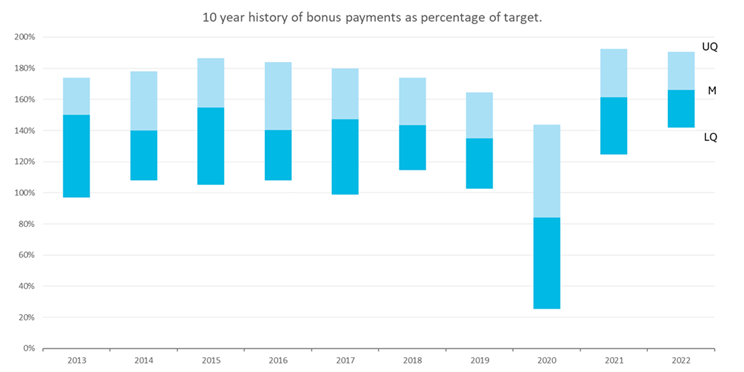
Over an extended period (and noting 2020 was an exceptional year), typical payouts have been 140-160% of the stated on-target level. While critics may suggest this flows from soft target setting rather than genuine out-performance, we suggest that, it recognises that overall headline quantum is insufficient to achieve its purpose which has led to too much clustering around that 140-160% level. This could be corrected through increasing total bonus opportunity by c. 1.5x with a clear understanding that a more conventional standard deviation should arise, i.e. performance that achieves a “normal stretch” budget should lead to a 100% of target payment (with the same pound value as now) and a similar number (say 20% of cases) of companies materially under and over performing this. The challenges in achieving this should not be underestimated but (as the CMIT initiative suggests) it’s time for a resetting of trust between shareholders and Boards and shareholders can police this through the existing annual voting on pay outcomes.
We hope this will prompt further discussion.
Partners
Rory Cray
rory.cray@fit-rem.com
020 7034 1116
Darrell Hare
darrell.hare@fit-rem.com
020 7034 1113
Matt Higgins
matt.higgins@fit-rem.com
020 7034 1117
Alison Kidd
alison.kidd@fit-rem.com
020 7034 1773
John Lee
john.lee@fit-rem.com
020 7034 1110
Sahul Patel
sahul.patel@fit-rem.com
020 7034 1778
Iain Scott
iain.scott@fit-rem.com
020 7034 1114
Richard Sharman
richard.sharman@fit-rem.com
020 7034 1774
Katharine Turner
katharine.turner@fit-rem.com
020 7034 1115
Matthew Ward
matthew.ward@fit-rem.com
020 7034 1777