No images? Click here


FIT Summer Briefing
In our summer briefing we cover two distinct consultations underway:
- Review of the Equal Pay framework
- Reform of the remuneration codes related to solo regulated firms
Reform of the current Equal Pay framework
It is worth stating upfront that references to pay transparency often refer to a myriad of different regulations rather than a single requirement. It often includes the legislation regarding equal pay and gender (and other special category) pay gap reporting. When introduced in the EU, the elements included a requirement to include a salary band when advertising to recruit, a right for colleagues to ask for certain information relating to the pay of their most comparable colleagues and a ban on asking candidates for their historic pay information.
Following this introduction of pay transparency legislation in EU countries in June 2026 and the numerous consultations in the UK in recent years, our clients often ask us when we think equivalent legislation will come in to force in the UK. While there is no set timescale for this yet, a further consultation was launched on 14th July 2026, reaffirming that it is still very much on the agenda albeit the immediate focus is on enhancing equality legislation and reporting rather than giving specific rights to ask for other individuals' pay information or banning asking candidates for such information (with such requests being through a voluntary questionnaire). At its most basic level, this ties in with the current commitment of the Government to remove the different age bands for minimum wage rates.
The consultation can be found here.
History
The framework for UK pay transparency has evolved through successive consultations, moving from basic gender reporting to a current proposal to overhaul the equal pay system.
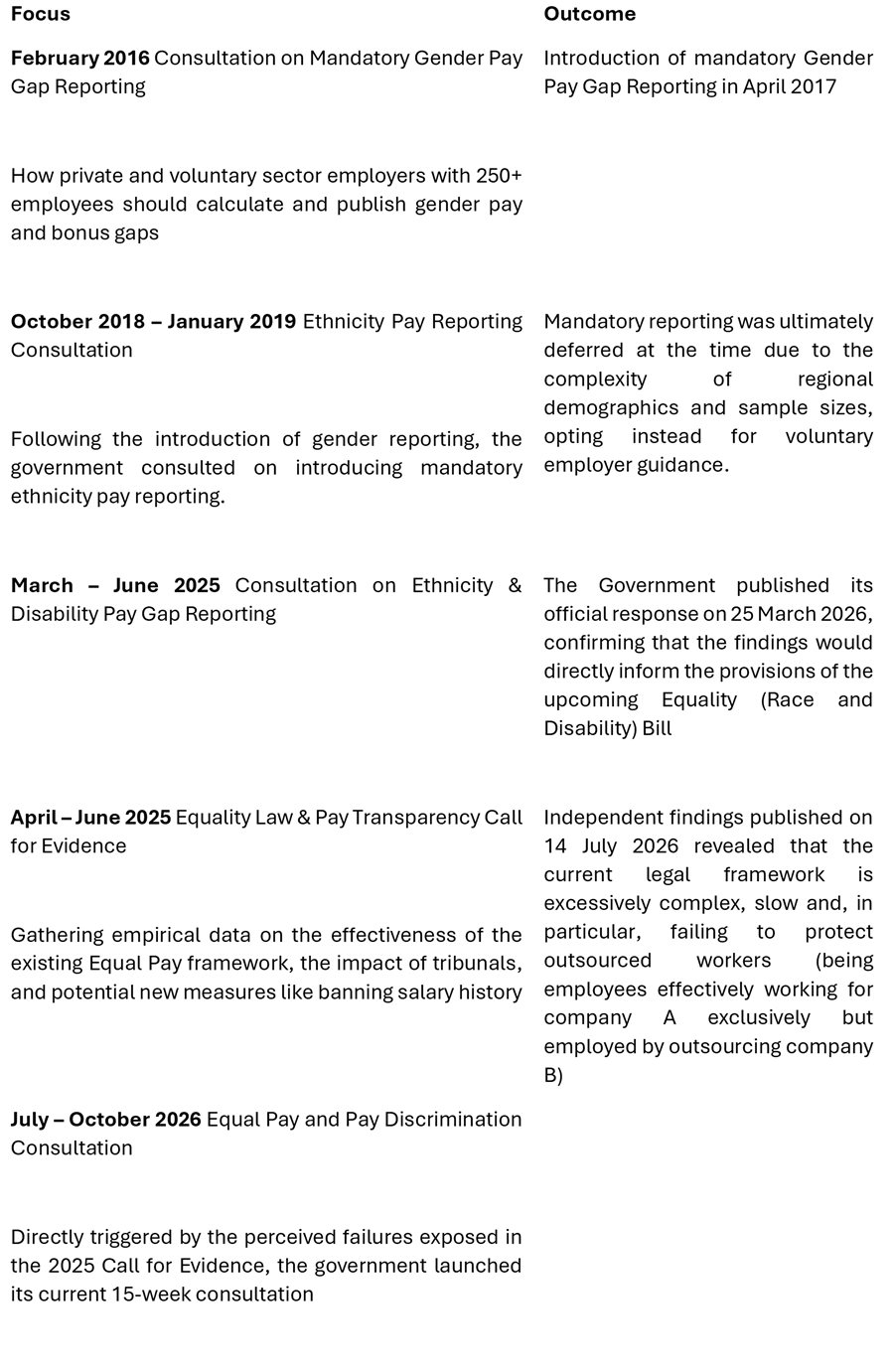
This briefing summarises the current consultation on overhauling the equal pay system.
The Government has recognised systemic failings in the current equal pay framework around:
- A lack of tools to identify discriminatory pay practices
- A significant burden on the justice system by incentivising arguments over minor details of a dispute. This has resulted in thousands of claims currently waiting to be heard, creating stress for employees and uncertainty for employers
- Lack of protection for those who particularly need it; disabled employees, those from ethnic minorities and outsourced workers.
It outlines a phased approach to modernise the pay discrimination framework:
- Phase 1 - Improving the current system by streamlining process and strengthening transparency and enforcement
- Phase 2 - Once the system is improved, broadening protections to close gaps in the law.
The Government has committed to seek an ‘extended implementation period’ to ensure sufficient preparation time for employers and the tribunal system.
Phase 1
Pay Transparency
Pay transparency measures are seen as key tools in making pay discrimination less likely to occur and to shift the focus from reactive litigation to proactive prevention by encouraging employers to resolve issues quickly. The proposals are to:
- Introduce statutory inclusion of pay and conditions information in job adverts
- Strengthen sanctions for employers reasonably suspected to have committed pay discrimination. These sanctions are to include a mandated equal pay audit (this currently exists but is not uniformly applied and contains many exceptions) and a mandated introduction of a non-discriminatory job evaluation scheme. While these steps will only be required as a sanction (i.e. those in breach or whom the new enforcement authority has reasonable suspicion is in breach), many companies may wish to consider compliance or periodic equal pay audits as a proactive preventative measure
- Reinstate the statutory questionnaire procedure in pay discrimination cases. This is a standard questionnaire a claimant can request the employer to complete, hopefully resulting in early resolution of the claim. Although not likely to be mandatory for an employer to complete the form, if a claim goes to tribunal, inference can be drawn from an employers’ refusal to complete the questionnaire. This was previously a statutory requirement under the Equality Act 2010 but was repealed in 2013 as it was thought to be too burdensome. The Government’s hope is that more employers will choose to complete the new (shorter) questionnaire. There is no further detail yet on which questions will be included but these are likely to focus on establishing if a perceived comparator is a true comparator, requesting details of pay and conditions for a comparator role and seeking views from employers on why a claimants pay is lower than an identified comparator
These proposals currently being consulted on differ from those in the EU Directive which also:
- Ban employers from asking candidates about their current or past compensation packages
- Mandate that all job titles, descriptions, and recruitment processes must be entirely gender-neutral
- Give workers the right to request written information detailing their individual pay level and the average pay levels broken down by sex for colleagues doing equal work (subject to some confidentiality protections to prevent individual data from having to be provided).
- Ban pay secrecy clauses in contracts
- Require Employers to make their criteria for determining pay levels and career promotion easily accessible to staff.
We are wary of drawing too much comfort from these not being included in the current consultation as they could still form part of the overhauled equal pay regime, possibly in a next phase.
Pay Discrimination Enforcement
Over ten thousand equal pay claims are lodged every year making the litigation process complex, lengthy and expensive. The majority of claims are brought by individuals. While the Equality and Human Rights Commission (EHRC) has powers to bring claims, investigate and apply sanctions, their intervention has been limited (their most high-profile intervention being the pay discrimination case at the BBC in 2019).
The consultation seeks views on the process for bringing pay discrimination claims and also the role of the independent panel of experts (the expert panel which advises the tribunal on whether the work of claimants and comparators is of equal value).
A new Enforcement Unit is being mooted (Equal Pay, Regulatory and Enforcement Unit) with a focus on prevention (e.g. creating toolkits for employers) but ultimately with enforcement powers. These powers may include:
- Empowering the unit to demand evidence before deciding to trigger a formal investigation
- Enabling the unit to require that a job evaluation process or equal pay audit is undertaken to help determine if pay discrimination has occurred
- While the EHRC currently has power to undertake an inquiry, any recommendations it makes are not binding. The Unit may be given the ability to follow up on recommendations made.
Views are sought on the most appropriate institutional home for this unit but it seems most likely this will be housed within the existing EHRC.
Phase 2 – Extending equal pay protection to those who are discriminated against on the basis of race or disability
Currently, Sex Discrimination claims concerning pay must be brought as equal pay claims which follow distinct legal procedures compared to race or disability discrimination claims involving pay which are brought under the Equality Act. The remedies and protections available to claimants therefore differ. The proposal is not to simply extend equal pay legislation to cover race and disability (this would cause delay by requiring significant reform to enable it to be effective) but rather to keep the two approaches separate but level up the protections offered under each legislation. The following changes are being consulted on:
- Under the equal pay regime, an equality clause already automatically exists in the employment contract if the employee is carrying out equal work to a comparator of the opposite sex. This is not the case under discrimination legislation where the claim is on the grounds of race or disability. The proposal is to enable to tribunal to enforce the modification of a contract where it is found to be discriminatory.
- Where a tribunal finds an equal pay breach, it can order the respondent to conduct an equal pay audit. As mentioned above, the exceptions to this are also proposed to be tightened. It is further proposed that the tribunal can order a job evaluation framework to be implemented. It is proposed that these steps are mirrored in discrimination claim outcomes and therefore effectively apply in race and disability cases too.
- The concept of equivalent work. Under equal pay legislation the work of a man and a woman can be deemed equal if it: (a) Is like work i.e. the same or similar work; (b) Is rated as equivalent i.e. has been rated the same under a formal job evaluation scheme (c) Is of equal value i.e. is different and has not been rated under a formal job evaluation scheme but is deemed to be equal in terms of demands such as skill and decision making.
No such equivalent legislation exists under discrimination laws which require there to be no material difference between the claimant and the comparator. It is proposed to enable claims for pay discrimination where work is rated equivalent or of equal value.
- A technical change to equal pay claims to allow the use of hypothetical comparators in specific scenarios.
- Removal of the time limit in which an equal pay claim must be made (currently within six months of employment ending) to align with a discrimination claim where the tribunal has discretion to extend the timescale.
The upshot of these changes will be to make it easier for someone claiming pay inequality due to race or disability to bring a claim as the standard needed to succeed in a claim and the outcomes they can hope to achieve will mirror that of a man or woman bringing an equal pay claim.
Outsourcing
Currently equal pay claimants cannot use a comparator with a different employer, hence making it possible for employers to avoid equal pay claims by using an outsourcing model. The current proposals seek views on how best to ‘level-up’ pay between employees and outsourced workers and suggests a duty is placed on contracting parties to uphold equal pay in their contractual arrangements. Given the prevalence of outsourcing for many lower paid areas of work, this could be a significant area of exposure and one which, at least potentially, insources back some legal liability if outsourced employees are not receiving equal pay treatment. To date, many companies have not felt it appropriate to investigate the levels of pay of their outsourced employees (beyond basic human rights or living wage compliance) and this change could significantly revise this. Companies may also wish to consider the protections in the outsourcing agreement as to whether the provider is indemnifying the position.
How FIT can support
We are supporting clients to understand what the proposed legislation may mean for them both immediately and into the future. Some clients are opting to carry out an equal pay audit now to highlight any issues they may need to address in advance of increased transparency. Other clients are revising or even introducing grading frameworks and / or job evaluation systems to aid compliance with the transparency requirements. If you would like to discuss how we can help your organisation, please get in touch.
FCA consulting on a reform of remuneration rules for solo regulated firms
The tightening of regulation aimed at addressing excessive risk-taking and weak incentives in banks, following the banking crisis in 2008, was subsequently extended to non-bank firms via a number of similar but distinct frameworks (SYSC 19B – Alternative Investment Fund Managers (AIFMs), SYSC 19E – UCITS Management Companies and SYSC 19G – MIFIDPRU Investment firms).
The FCA has received feedback that the various frameworks can be burdensome and difficult to navigate and have themselves concluded that they may impose unnecessary complexity and administration on firms that do not pose systemic risk. They also go further than the principles-based approaches adopted in many other jurisdictions. Following recent reforms in banking regulation, the FCA is now consulting on a simplification of these frameworks.
With this review the FCA is aiming to:
- Promote remuneration practices that encourage good conduct, healthy culture and align with the interest of clients, funds and investors
- Ensure requirements are proportionate to a firm’s size, activities and risk profile
- Simplify the framework to improve usability for firms and regulatory supervision
- Reduce regulatory burden while maintaining guardrails
These proposals sit alongside a broader review of the regulatory framework for AIFMs (see here) and tie in with HM Treasury’s stated intention to revoke AIFM Level 2 regulations (which will remove from statute the legislation relating to remuneration requirements for AIFMs).
Due to the need to align with the broader review, it is expected that the changes proposed in this consultation will be introduced in two phases; phase 1 for full scope UK AIFMs from performance periods commencing after a date to be confirmed but expected be during Q1 2027 and phase 2 for medium and large UK AIFMs at a later date once the AIFM reforms take effect.
What is being proposed?
1. Replace the three existing remuneration codes (SYSC 19B, SYSC 19E and SYSC 19G) with a single, consolidated new code for in-scope solo-regulated firms (SYSC 19AA)
Firms that are compliant with their current code should expect to remain compliant with the new consolidated code.
2. Move away from detailed, prescriptive rules towards a more outcomes-focused approach based on firm governance and accountability.
There will be a requirement for firms to have strong governance and oversight practices but specific structures will not be prescribed. The mandate requiring firms to have a remuneration committee will be removed as will the requirement to conduct a formal annual remuneration review.
3. Application and Structure
The code will apply distinctly to two groups of individuals:
Staff (employees, partners, members, secondees, employees of other group entities providing services) – general remuneration requirements to apply and will include:
- Remunerating staff in control functions on the performance of the function, independent of the business and for senior control functions employees their remuneration should be overseen by the management body
- Policies must contain measures to avoid conflicts of interest
Material Risk Takers (see point 7 below for definition) – additional remuneration requirements will apply:
- Making a clear distinction and an appropriate balance between fixed and variable pay
- Assessing performance on both financial and non-financial criteria (to include conduct and risk management)
- Only using guaranteed variable remuneration in specific circumstances (see point 4 below) (primarily for hiring / buy-out situations). Such awards should be time limited and not ongoing and be subject to adjustment
- Ensuring severance pay is performance related and does not reward failure
- Deferral (see point 4 below)
- Performance Adjustment mechanisms should be considered but will not be mandatory (see point 4 below)
4. Deferral, malus and clawback and guaranteed variable remuneration
Current codes require firms to use deferral, malus and clawback to align pay with long term performance. The proposal is to move to a more principles-based approach; however, the FCA recognises that firms may prefer the new code to retain a mandatory element and is therefore consulting on two options:
Option 1 (FCA preferred): firms to determine the most appropriate deferral policy for their business with freedom over deferral periods, percentage requirements, cash v instruments split, vesting schedules and holding periods
Option 2 – threshold-based rule: mandatory deferral with a minimum deferral period for firms above specified thresholds. The thresholds have not been decided but are likely to align with the PRA Rulebook (which applies to dual-regulated firms under SYSC 19D) which would see no deferral in firms with less than £4bn total assets and firms with between £4bn and £20bn total assets applying deferral proportionately
It is recognised that an assets-based metric may not translate neatly to all solo regulated firms and the FCA is seeking views from firms on more appropriate alternatives.
A similar proposal is also being put forward on malus and clawback – a principles approach is favoured by the FCA where there will be an expectation on firms to consider malus and clawback provisions appropriate for their own business rather than a new Code containing didactic rules.
And the proposal is to simplify current rules on guaranteed variable remuneration which the FCA views as being potentially appropriate on recruitment-related buy-outs (and also potentially for retention-related matters) provided such awards operate consistently with the wider provisions of the new code (including expectations on malus and clawback and expectations on conduct, governance and risk alignment).
5. Revoke MIFIDPRU remuneration reporting and disclosure requirements
There will be no reporting or disclosure requirement under the new code, recognising the current costs of compliance.
6. Scope
There is no scope change for AIFMS and UCITS firms. For MIFIDPRU firms, the current tiering structure (basic, standard and existing requirements) will be removed and the new code will apply only to non-SNI MIFIDPRU investment firms. Small and non-interconnected MIFIDPRU firms will not be covered by the new code and are therefore exempt from remuneration rules.
7. Material Risk Taker (MRT) definition
The definition will be narrowed to a staff member at an in-scope firm whose professional activities or remuneration incentives have a material impact on any of the following:
- The firm’s conduct in relation to its clients and investors
- The interests of investors, the AIFs, the UCITS schemes
- The firm’s compliance with obligations under the regulatory system
This will mean that some individuals will no longer be subject to the certification regime. As an aside, a consultation on the certification regime is expected later this year
How FIT can support
The loosening of the regulations will likely lead to many in-scope firms reviewing their policies around deferral (if it becomes voluntary) and their Material Risk Taker population. Market data on how other firms are responding to these changes will be interesting. It is likely that for most firms the new code will be effective for performance periods beginning in January 2028 which gives remuneration committees some time to consider if their current approach needs to change. FIT is ready to support our clients with these conversations.
If you wish to discuss anything arising from this briefing, please ask your usual contact at FIT or email us using the button below.
Partners
Rory Cray
rory.cray@fit-rem.com
020 7034 1116
Darrell Hare
darrell.hare@fit-rem.com
020 7034 1113
Matt Higgins
matt.higgins@fit-rem.com
020 7034 1117
Alison Kidd
alison.kidd@fit-rem.com
020 7034 1773
John Lee
john.lee@fit-rem.com
020 7034 1110
Sahul Patel
sahul.patel@fit-rem.com
020 7034 1778
Iain Scott
iain.scott@fit-rem.com
020 7034 1114
Matthew Ward
matthew.ward@fit-rem.com
020 7034 1777
Martin MacLeod
martin.macleod@fit-rem.com
020 7034 1111