No images? Click here

If you would prefer to view the briefing as a PDF, please click here.
Executive briefing – February 2021
Some questions being considered by Remuneration Committees
Listed companies reporting early in 2021 and their Remuneration Committees are already in a period of intense activity. Many are considering how to determine appropriately and fairly outcomes for 2020 and how to approach pay for 2021, against the backdrop of an enduring pandemic.
The effects of the pandemic compound remuneration-related challenges even for those companies which have performed well for part or all of the year. A little over half of companies responded quickly when the pandemic first hit the UK by making changes to senior executive remuneration (such as, temporary reductions in salaries, reductions or delays in payment of variable pay and/or increased payment in deferred shares or deferring the target setting process). This was often done where dividends were reduced or cancelled, or where employees were furloughed (with funding from the government) or made redundant. Boards wanted to make clear that they were playing their part.
Proxy advisors and commentators expect to see restraint at the top and for companies to demonstrate how and why the pay of their senior executives is appropriate and ‘fair’. On the other hand, in many cases, leadership teams have never worked so hard and have been instrumental in keeping their companies going through the most severe of challenges.
Satisfying the expectations of all stakeholders in 2021 will be very challenging and FIT has considered here some of the questions we think will help to achieve a delicate balancing act. Our thoughts have been informed by our recent client experiences alongside analysis of the ‘early reporters’ in 2021 (i.e. those companies with September 2020 year-ends companies). It is important to stress at the outset that there is no ‘right answer’ and that this briefing simply seeks to highlight some of the key issues to consider. Each company will both need to consider its unique circumstances and its own view on balancing management’s contribution with the risk of shareholder criticism. Initial voting experience certainly shows that shareholders are willing to vote against decisions which were more likely to garner support in previous years.
Base salaries
Q. Is it appropriate to increase base salaries?
- Salary increases above the going rate for all employees were difficult to implement even before the onset of the pandemic and require a compelling rationale beyond benchmarking. In recent years, there has been pressure on some companies to explain why a workforce-aligned increase was necessary.
- The effect of the pandemic has been to compound this, particularly for those companies that have been impacted most significantly and for those where stakeholders have suffered.
- The effect of the pandemic on employees will be a key reference point to consider – what is the proposed salary increase across the company, have staff been furloughed, and have there been any pandemic-related redundancies? In addition, has government financial support been relied upon in any way (and, if so, has it been paid back)?
- Even if not impacted by the pandemic, and where company performance has been strong, the current investor environment remains hostile and investors are questioning whether now is the right time for a significant salary adjustment. Salary increases and corrections are possible but need a more robust justification and acceptance of the risk of adverse voting than was the case prior to the pandemic.
- On a related matter, for new joiners, the level of base salary will receive close scrutiny and will not simply be a case of negotiation between the company and the individual. How the salary compares to the predecessor’s is a key point of focus and any subsequent proposed increase will be considered against this reference point. Expect resistance from ISS and investors where salaries for newly-appointed executive directors are higher (or even at the same level if the market cap has fallen materially).
- Amongst 31 recent reporters:
- Around 2/3 received no annual increase (typically this has been closer to 1/3 in recent years).
- Of those making increases, the majority are in the 2%-3% range (i.e. broadly aligned with employees generally).
- Two companies made significant (20%+) increases, both as part of a fundamental review of policy. Notwithstanding strong sustained performance over recent years (and through the pandemic) both received vote against recommendations from ISS with salary being one of the main points of concern.
- Just over half temporarily reduced salary for a period following the initial lockdown, consistent with practice across the FTSE All-Share as a whole.

Q. We froze salaries last year due to the pandemic and would like to make a catch-up increase. Is this ok?
- The answer to this depends on the Board’s and the Remuneration Committee’s appetite for risk. The proxy agencies and investors have never been receptive to ‘catching up’ increases and given that general inflation is currently less than 1%, the argument is even harder to make even if salaries for employees generally are going up by 1.5% or 2%. Any salary increase above the ‘going rate’ is likely to attract scrutiny. The view of the Board on how stakeholders’ interests are best met may differ from, say, ISS’ judgement. Be prepared to engage with shareholders and to take a higher than typical proportion of votes against the Directors’ Remuneration Report even when there is a strong commercial case to be made.
Annual Bonus outcomes
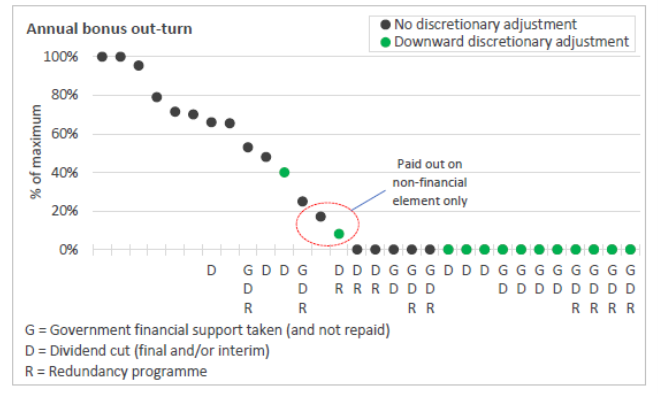
In recent years, the median bonus payout has been around 60%-80% of maximum and it is clear that this will fall significantly in 2021. Based on the early reporters, around half have paid no bonus and just two have paid a full bonus.
Q. Is it right to pay a bonus if we have relied upon the government’s furlough scheme, cancelled dividends and/or made employees redundant?
- This may be the most difficult question that Remuneration Committees are currently wrestling with. While some shareholders may suggest that it is an easy question to answer, it casts doubt on the integrity of the bonus process to simply zero bonuses. Companies will need to demonstrate not only that out-turns are aligned with financial and share price performance but that they are ‘fair’ taking account of a number of factors including, in particular, the experience of the full range of stakeholders. The Directors’ Remuneration Report should take shareholders carefully through the Remuneration Committee’s thought processes and show why the decision is appropriate.
- Remuneration Committees will need to carefully balance operational risk and reputational risk. In short, out-turns in 2020 will be as much about public relations as they are about rewarding performance and/or talent retention and engagement. The communication of the rationale – both internally and externally – will need to be especially effective and the decisions (whichever way they go) are unlikely to be popular with all stakeholders.
- The proxy voting agencies have tended to take a binary and somewhat unnuanced position which does not allow for much acknowledgement of the specific circumstances companies are facing or the executive expertise required to keep companies solvent during arguably the most difficult of crises. Proxies and some of the more vocal investors have been clear in their guidance to investee companies that, where there has been equity/fund raising, or where the company has relied on government financial support and furloughed employees without paying monies back, no bonuses should be paid for 2020. Where dividends have been reduced or cut or where there have been COVID-19 redundancies, then this should be factored into the bonus outcome (suggesting the use of negative discretion).
- How employees across the workforce have been affected (including whether staff generally received some level of bonus payment), the extent to which government financial support has been relied upon, and any cut to the dividend will therefore be key reference points and companies will need to justify the fairness of their incentive payouts taking particularly close account of these.
- Amongst the most recent reporters, close to half of companies made discretionary downwards adjustments – the majority reducing down to zero (often waiving the non-financial elements of the payouts).
Q. What scope is there to use upwards discretion to pay a bonus?
- Technically, this may be possible under the Directors’ Remuneration Policy. Not all Policies are the same though so it is necessary to check. Even if your Policy allows for it, it does carry a significant risk of a vote against recommendation from the major proxies. Where this is considered an appropriate course of action, we would suggest either that ‘it is better to ask for forgiveness than permission’ or a small consultation/call with the company’s top two or three investors – but be prepared for push back. Essentially any company being seen to favour the management team without showing how other stakeholders have benefited, needs to do so conscious of the risk of shareholder challenge.
- While none of the September 2020 year-end companies appear to have made upward discretionary adjustments to bonus out-turns, there were a handful that did so earlier in 2020, generally resulting in very significant shareholder dissent.
- It is, of course, necessary to differentiate adjustments to make targets easier from more definitional changes to ensure that the targets operate as intended and avoid windfall gains (for example many emission targets may need adjustment to reflect the lower level than anticipated of economic activity).
Q. How about paying out on non-financial targets where profit targets are not achieved?
- Some companies have profit underpins attached to their non-financial targets and removing these would be considered to be the use of upwards discretion and likely to lead to a level of adverse voting – see above.
- For others, this could be considered and we would suggest a compelling narrative explaining how and why the company has acted like a good corporate citizen is included in the justification. The level of push back here will depend on the specific circumstances, taking into account a holistic assessment of company performance and the impact on employees and shareholders.
- Two companies among the recent reporters took this approach. In isolation, some level of payment (albeit potentially not a maximum payment) is not likely to be ‘vote against’ territory for the proxy agencies providing that there is no profit underpin being disapplied, though is likely to be at least flagged as ‘contentious’ by ISS.
- Paying a bonus where financial targets have been moderately missed may be less transgressive than paying a bonus where no profit has been generated.
Q. Does it help to deliver the bonus in deferred shares?
- This is more about the appropriateness of paying a bonus in principle (and note the single figure will be the same whether bonus is delivered in cash or deferred shares). However, paying the bonus in shares and/or deferring payment may help at the margins.
Setting 2021 bonuses
Q. How are companies tackling the lack of full-year visibility in structuring bonuses for 2021?
- Aside from COVID-19, 2020 also saw a keen focus on ESG generally (particularly diversity and environmental concerns) and we are seeing some increased focus on such measures for 2021 although some proxies and shareholders are wary of this representing too high a proportion of any bonuses.
- Companies are considering even more carefully the choice of measures and the calibration of targets for the year ahead, particularly in the context of low or nil bonuses for 2020 performance.
- From our recent discussions, most Remuneration Committees are retaining the broad bonus structure although a significant minority have increased the non-financial element (circa 25% of the most recent reporters) or have removed any profit underpin.
- Alongside this, we are seeing wider target ranges and some delay in the actual setting of the range, careful consideration of how the range compares to FY2019 and FY2020 actual performance, and the laying of a discreet hint where the use of discretion may be under consideration when determining out-turns in 2022.
- A small minority have split the year in two (e.g. four recent reporters). The challenge here is to ensure there is appropriate discretion at the end of the year to reflect the full picture.
- While we consider it important to ensure that the 2021 bonus opportunity has motivational impact and that any harsh treatment applied in 2020 is ‘one-off’, given the level of uncertainty, many companies will need to acknowledge that simply following a formulaic approach is likely to be difficult and that achieving the formulae in unforeseen ways may not warrant a bonus.
LTIP vesting
In recent years, the median level of LTIP vesting has been around 50%-60% of maximum and, as with the bonus, vesting levels are likely to be much lower in 2021, particularly for those with financial measures.

Q. What scope is there to use discretion to adjust the vesting outcome?
- As per the annual bonus, upward discretion remains controversial and is likely to result in significant investor dissent. If being considered, it is also important to check that the LTIP rules and grant documentation permit upward discretion.
- Vesting levels in the majority of cases have been determined in line with the normal formulaic outcomes. However, in contrast to bonus, where discretionary adjustments were all downward, we have seen limited instances of upward discretion on LTIP vesting so far and these actions have so far elicited adverse reaction from proxies and shareholders.
- Of the three early reporters using upward discretion:
- One stripped out performance post-pandemic i.e. shortened the performance period (receiving a vote against recommendation from ISS and narrowly passing its pay resolution at its AGM last week).
- One removed a particular measure and redistributed its weighting across the other measures.
- One was in relation to a takeover (i.e. not related to the pandemic).
- Unlike with bonuses, only one of the early reporters made a downward adjustment (to zero).
Q. Is there any evidence yet of companies adjusting the terms of in-flight LTIP awards?
- This has been discussed in many recent Committee meetings. Companies are generally looking at their in-flight awards and considering what, if any, action to take. While no companies have so far disclosed changes to in-flight awards, we expect a small minority will consider this and put forward proposals over the coming months.
- If you are considering this, we suggest you consult extensively with leading shareholders well in advance and explain fully the rationale and be prepared for challenge.
- The proxy guidance issued to UK companies in April 2020 was clear on this topic - the leading proxy advisors do not expect adjustments to be made (although it is worth noting that Glass Lewis' latest publication for EMEA companies - potentially indicating a more liberal approach for at least some European, if not UK, companies - suggests that it could be acceptable in some circumstances if the level of vesting is then reduced).
Awards to be made in 2021
Remuneration Committees are considering carefully the timing of awards, whether there should be any scale back to reflect a lower share price or scope to use discretion upon vesting, and the most appropriate performance metrics to use at a time when there is very little ability to forecast beyond the next quarter.

Q. Can we delay the grant?
- Many companies took the opportunity to delay their 2020 grant (in the event these had not already been made before the onset of the pandemic).
- The most recent proxy voting guidance suggests that companies should now aim to revert to their normal timing for the 2021 awards.
- With the UK currently in lockdown and for several weeks more, we may see some companies grant later than typical, for example, after the AGM rather than at the point of the full year results announcement, as is normally the case.
- Four of the early reporters have stated that they are delaying the grant and this does not, so far, seem to be controversial with investors.
- Around 30% have not disclosed the measures and targets in their remuneration reports, thereby giving themselves some time by generally committing to doing so at the point of grant.
- Some companies have made their awards at the usual time but delayed the decision on targets.
Q. Should we change measures for the forthcoming award?
- Assuming the policy permits this (and most will), we strongly recommend you consider whether the subsisting measures remain appropriate.
- Where companies are struggling to set robust financial targets, some have moved to TSR or increased the TSR weighting, and there is also some evidence of absolute share price being used (e.g. a quarter of early reporters have made changes to their measures and/or weightings).
Q. What broader trends are you seeing?
- We are seeing much more creativity in the approaches being taken below Board – including amendments to performance criteria, the use of ad hoc awards of restricted shares and all-employee bonuses to reflect sterling efforts during a difficult period.
- We continue to see interest in restricted shares not only at below Board level (where use has increased significantly in recent years), but for executive directors too. On top of the 20 or so new schemes introduced in 2020, we are aware of many companies that are consulting with shareholders currently on introducing restricted shares as part of newly adopted policies in 2021. We think companies should avoid taking too tactical an approach to restricted shares and resist a move solely on the basis that three-year targets are too hard to set.
- A small number of companies have adopted more highly-geared one-off ‘recovery’ plans and such schemes may be appropriate, particularly where there is a highly concentrated shareholder register with support from the largest investors.
- Many companies in 2020 did not scale back the size of LTIP grants to reflect lower share prices, but instead included a commitment to consider reducing vesting levels to avoid ‘windfall’ gains. The IA has requested that companies include in their Directors’ Remuneration Report a statement of the factors which will be taken into account in considering whether there has been a windfall gain. So far, there has been relatively little disclosure on this. Their guidance also suggests that this should not be repeated in 2021 and that, where the share price has fallen materially (from pre-COVID levels), it should lead to some scale-back in grant levels. This is likely to be contentious with affected executives who have accepted material reductions in in-flight awards but expect to be rewarded for growth from here on in.
Whatever decisions are taken, Remuneration Committees and management teams should expect decisions on executive remuneration to take more time in the present context. Decisions, however carefully considered, are likely to be more controversial both internally and externally. The ‘COVID’ factor is for now an inescapable consideration which makes anticipating outcomes and reactions more than usually difficult. The best Remuneration Committees can do is to be as well briefed as possible and then use their judgment to decide what is appropriate in the knowledge that the balance of interests on executive pay in listed companies will be even more than usually difficult to strike.
If you wish to discuss anything arising from this briefing, please ask your usual contact at FIT or call us on 020 7034 1111 or email us at Info@fit-rem.com.
Rory Cray
rory.cray@fit-rem.com
020 7034 1116
Darrell Hare
darrell.hare@fit-rem.com
020 7034 1113
Matt Higgins
matt.higgins@fit-rem.com
020 7034 1117
John Lee
john.lee@fit-rem.com
020 7034 1110
Sahul Patel
sahul.patel@fit-rem.com
020 7034 1778
Iain Scott
iain.scott@fit-rem.com
020 7034 1114
Katharine Turner
katharine.turner@fit-rem.com
020 7034 1115
Matthew Ward
matthew.ward@fit-rem.com
020 7034 1777
This paper is intended to be a summary of key issues but is not comprehensive and does not constitute advice. No legal responsibility is accepted as a result of reliance on the contents of this paper.
This email is confidential. If you are not the intended recipient, please delete the email and do not use it in any way. FIT Remuneration Consultants LLP (FIT) does not accept or assume responsibility for any use of or reliance on this email by anyone, other than the intended addressee to the extent agreed in the relevant contract for the matter to which this email relates (if any). Consistent with data protection regulations, if you would like to review our records relating to your contact details or to request their removal from our systems, please contact us at info@fit-rem.com. While all reasonable care has been taken to avoid the transmission of viruses, it is the responsibility of the recipient to ensure that the onward transmission, opening or use of this message and any attachments will not adversely affect its systems or data. No responsibility is accepted by FIT in this regard. FIT is a limited liability partnership registered in England under registered number OC364396, with its registered address at 1 Duke Street, London, W1U 3EA.