No images? Click here

Adjustments to Remuneration
Our weekly update
The impact of coronavirus on each business can, of course, be rather different and despite the terrible human consequences which dwarf everything else, some companies are actually seeing an increase in their business activity. No one-size fits all solutions can possibly apply in this situation.
We are also seeing different responses from institutional shareholders and proxies ranging from PIRC’s call for a blanket withdrawal of variable pay arrangements to some more activist investors expressing sympathy for increased gearing in plans once the crisis is past and companies need to incentivise management to lead companies through a recovery. However, even the most bullish investors we have engaged with are wary of truly uncapped equity awards and would expect to see some element of capping to prevent windfall gains (citing certain housebuilders as their examples).
We think it premature to be definitive as to how executive pay may look after this is over (and would reiterate the lack of a one size fits all solution) but suspect neither extreme will prevail:
- It will continue to be necessary to retain and motivate high calibre executives
- It will be appropriate to provide clear incentives which differentiate between success and failure (and we regularly work with companies to roll out new incentive plans where the absence of a robust link of variable pay and performance management systems have led to a lack of corporate and individual ambition and companies generally need to guard against this)
- Restricted stock clearly has considerable merits in the context of market uncertainty and we expect to see increased use of these types of awards (perhaps with modest performance multipliers as a FIT partner introduced for Kingfisher almost 20 years ago)
However, this week’s data update focuses on more immediate actions with the thematic being towards salary cuts, bonus cancellation (but not, so far, cancellation of LTIP vestings) and deferral of LTIP grants. These currently remain very much minority practice and essentially fit into 2 categories:
- Cash conservation where companies seek to preserve liquidity
- Demonstration of leadership where executives wish to show solidarity with shareholders when reigning back on dividends
Not all companies are affected by these issues equally (and some not at all). Our analysis is not comprehensive so should be viewed as indicative of trends only.
Companies making salary cuts need to review the policy for its wider impact – will this track into pension allowances, bonus opportunity, LTIP award levels? At the risk of morbidity, does it automatically track into death in service insurances? We would expect insurance companies to agree that it need not if explicitly asked.
Some other companies are conserving cash through increased bonus deferral or exchanging cash salary for equity.
Again, we would mention that, in almost all cases we have been involved with, management itself has proactively volunteered such actions.
The table below outlines the adjustments to remuneration that have been publicly announced:
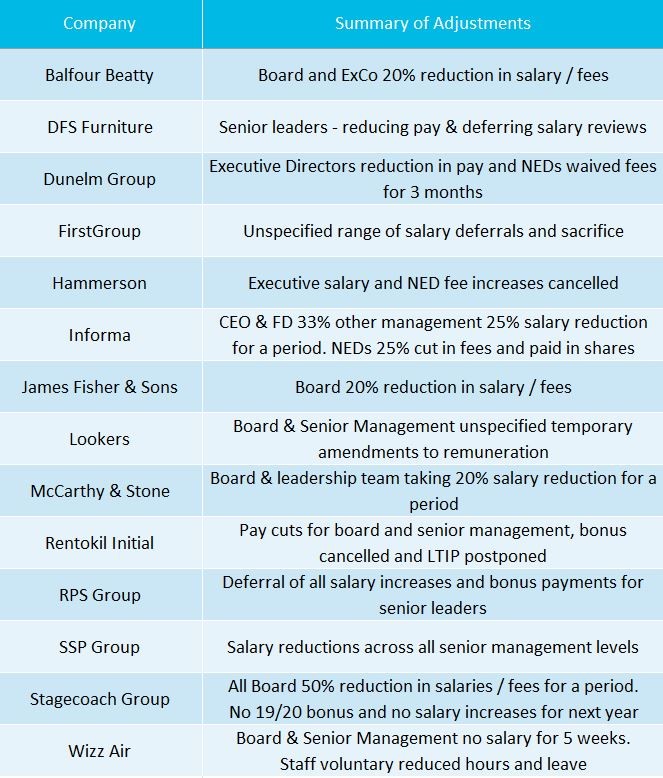
There are also a number of other companies that have been reported in the press as making adjustments following internal communications to staff, including those in the airline industry.
While typical reductions in a UK context seem to be 20-25%, it is interesting to see that US companies have also started equivalent reductions but that 40% of those reports analysed reduced salaries to zero. Its clearly early days but the US disclosures seem more pan-sector which may well prove the case here; indeed our own experience is that this is occurring more widely than disclosures as a number of companies have positively chosen not to announce at this stage.
If you wish to discuss anything arising from this briefing, please ask your usual contact at FIT or call us on 020 7034 1111 or email us at Info@fit-rem.com.
Rory Cray
rory.cray@fit-rem.com
020 7034 1116
Darrell Hare
darrell.hare@fit-rem.com
020 7034 1113
Matt Higgins
matt.higgins@fit-rem.com
020 7034 1117
John Lee
john.lee@fit-rem.com
020 7034 1110
Sahul Patel
sahul.patel@fit-rem.com
020 7034 1778
Iain Scott
iain.scott@fit-rem.com
020 7034 1114
Katharine Turner
katharine.turner@fit-rem.com
020 7034 1115
This paper is intended to be a summary of key issues but is not comprehensive and does not constitute advice. No legal responsibility is accepted as a result of reliance on the contents of this paper.
This email is confidential. If you are not the intended recipient, please delete the email and do not use it in any way. FIT Remuneration Consultants LLP (FIT) does not accept or assume responsibility for any use of or reliance on this email by anyone, other than the intended addressee to the extent agreed in the relevant contract for the matter to which this email relates (if any). Consistent with data protection regulations, if you would like to review our records relating to your contact details or to request their removal from our systems, please contact us at info@fit-rem.com. While all reasonable care has been taken to avoid the transmission of viruses, it is the responsibility of the recipient to ensure that the onward transmission, opening or use of this message and any attachments will not adversely affect its systems or data. No responsibility is accepted by FIT in this regard. FIT is a limited liability partnership registered in England under registered number OC364396, with its registered address at 1 Duke Street, London, W1U 3EA.